
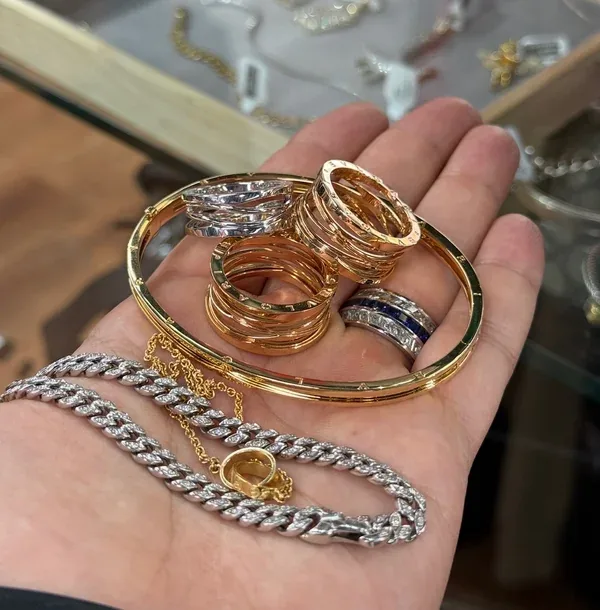
First, the disclosure most pages like this bury: we are a gold buyer. East Village Buyers pays cash for gold at 39 Avenue A, so we have an obvious stake in where you sell. Read everything below with that in mind — including the parts where we tell you we are not the right answer.
What follows is the whole NYC market as honestly as we can describe it: the Diamond District, pawn shops, mail-in services, bullion dealers, and neighborhood buyers like us — compared on the things that actually change your payout.
The Short Answer
The best place to sell gold in NYC depends on what you are selling. Recognized bullion bars and coins belong at a bullion dealer. Rare signed pieces and large estate lots deserve multiple quotes, including Diamond District specialists. Everyday jewelry, chains, and broken gold do best at a transparent buyer who shows you weight × purity × spot price at the counter. Wherever you go, the test is the same: if a buyer will not show the math, walk.
| Option | Payout reality | Speed | You watch the scale? | Best for |
|---|---|---|---|---|
| Neighborhood buyer | Judge by the math shown — weight, purity, spot, offer side by side | Same day, 15–30 min | Yes — demand it | Everyday jewelry, chains, broken gold |
| Diamond District | Varies suite to suite far more than sellers expect | Same day, plus the trip | Sometimes | Rare or signed pieces, large lots, quote-shopping |
| Pawn shop | Commonly the lowest — the business is loans, not buying | Instant | Rarely | Speed over price |
| Mail-in service | “Up to 85–90% of refined value” advertised — a ceiling, unverifiable until your gold is in their vault | About a week round trip | No | Sellers far from any walk-in buyer |
| Bullion dealer | Close to spot on recognized bars and coins | Same day to a few days | Varies | Bullion — not jewelry |
The Diamond District: Where the Trade Lives
West 47th Street is the center of New York's gold trade, and for some items that genuinely matters: rare coins, signed pieces from major houses, and large estate lots benefit from specialists who see them every day.
For an ordinary chain and a few rings, the picture is stranger. Much of the “we buy gold” business there is stacked into a handful of buildings — in some, six near-identical suites share a single floor, running interchangeable websites with interchangeable promises. In theory that concentration means easy comparison shopping. In practice, most sellers exhausted by the first upstairs office take the first number, and the shops know it.
If you go: get at least two quotes, stay on the ground floor of your patience, and make every buyer show the weight, the purity, and the spot price behind their offer. The good ones will.
Pawn Shops: Fast, But Built for Loans
A pawn shop's business model is collateral lending — buying your gold outright is a sideline, and the offers tend to price like it. That is not a scam; it is a different business wearing a similar sign. If you need cash in the next ten minutes and the number matters less than the speed, a pawn shop delivers exactly that. For anything else, it is usually the most expensive convenience in this list.
Mail-In Services: Read the Wording Before You Ship
The big mail-in operations are legitimate businesses with real review counts, and if you lived fifty miles from the nearest gold buyer they would be a sensible answer. In New York City, they ask you to accept three handicaps for no reason: you cannot watch a scale through a mailbox, you hear the offer only after your gold is already in their vault, and declining means waiting on return shipping.
Watch the wording, too. “Up to 85–90 percent of refined value” is a ceiling, not a promise — and refined value means the gold recovered after melting, not what the piece weighs on your kitchen scale. Those are different numbers, and the gap between them is where disappointment lives.
Bullion Dealers: The Right Answer for Bars and Coins
Here is a category where we will point you elsewhere without hesitation for some items: recognized bullion — sealed bars from known refiners, American Eagles, Maple Leafs, Krugerrands — trades close to spot, and dealers who specialize in it run tight, published spreads. We buy bullion too and will quote you honestly, but for a large holding it pays to compare our number against a specialist's. For jewelry, the reverse applies: bullion desks are not set up to price your chain.
Neighborhood Buyers: The Case for Staying Local — and Its Limits
This is our category, so hold the disclosure from the top of the page in mind.
The case for a neighborhood buyer is simple: the same arithmetic as anywhere else — karat, grams, live spot — run in front of you, with cash the same day and no trek. At our counter the scale faces you, the purity test happens where you can see it, and you are welcome to check spot on your phone while we weigh. That is not generosity; it is the only honest way to run this business.
The limits, honestly stated: a single shop cannot promise the theoretical top of the market on a rare signed piece or a six-figure estate lot — those deserve multiple quotes, including from the specialists uptown. And any one quote, ours included, is only as good as the math shown with it. If we ever quote you a number without the weight and purity next to it, treat us exactly like the red flags below.
How to Compare Offers Wherever You Go
- Weigh your pieces at home on a kitchen scale — grams, not ounces
- Read the karat stamps (417 = 10K, 585 = 14K, 750 = 18K, 916 = 22K)
- Run the numbers through our gold value per gram calculator to get today's melt value
- Get two or three quotes — every offer will be below melt; what you are comparing is the size of the gap
- Make each buyer show the weight, purity, and spot price behind their number
- If a quote comes in pennyweight (dwt), divide by 1.555 to get back to grams before comparing
Red Flags in Any Zip Code
- The scale is behind the counter, below it, or in another room
- A lump-sum offer with no weight or purity attached to it
- Quotes only in pennyweight, with no explanation of what a pennyweight is
- “Guaranteed best price” signage with no actual numbers anywhere
- No Secondhand Dealer license on display — every legal gold buyer in NYC must hold one from the Department of Consumer and Worker Protection (ours is DCA License #2070477)
The Verdict
Bullion: a bullion specialist — compare our quote against theirs. Rare, signed, or estate pieces: multiple quotes, including the Diamond District. Everyday jewelry, chains, and broken gold: a transparent buyer where you can watch the scale — and if you live below 14th Street, we would obviously like that to be us at 39 Avenue A. Bring the melt number from the calculator, and hold us to the same test we have told you to apply to everyone else.