
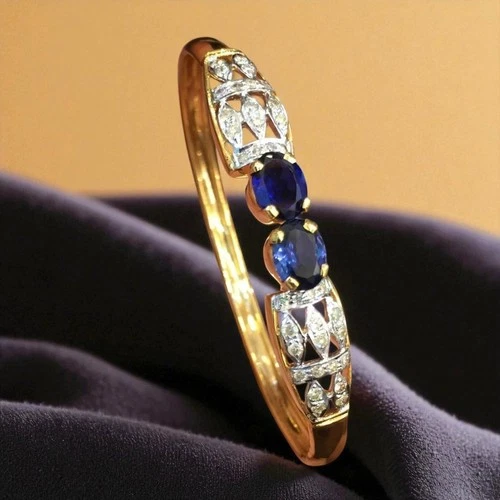
A real sapphire is very hard and usually shows tiny natural inclusions or bands of color under a loupe, while glass shows round bubbles and soft, worn facet edges. The harder question is natural versus lab-created, because lab-created sapphire is real sapphire too. Separating those often takes a gemologist or a lab report. Here's how to narrow it down, and what makes a sapphire valuable.
What Is a Sapphire?
Sapphire is the mineral corundum, the same mineral as ruby. Red corundum is called ruby, and every other color is sapphire: blue most famously, but also pink, yellow, purple, green, white and the rare pinkish-orange padparadscha. At 9 on the Mohs scale, sapphire is the hardest common gemstone after diamond, which is why it's so popular in everyday jewelry like the bangle pictured.
Signs of a Real Sapphire
- Crisp facet edges. Sapphire is hard enough that its facet edges stay sharp after years of wear. Glass gets rounded, scuffed and chipped edges.
- Natural inclusions. Under a loupe, natural sapphires often show fine needle-like inclusions called silk, tiny crystals, or fingerprint-like patterns.
- Straight color zoning. Natural sapphires often show straight or angular bands of stronger and weaker color.
How to Spot a Lab-Created Sapphire
Lab-created sapphire has been made since the early 1900s and is extremely common, especially in older class rings, birthstone jewelry and vintage costume-quality pieces. The most common kind, made by the flame-fusion process, often shows curved growth lines and tiny gas bubbles under magnification. Natural sapphire grows in straight lines, so curved banding is a strong sign of a lab stone.
Lab sapphires also tend to look flawless with perfectly even color. Other growth methods are harder to detect, and a lab report is the reliable answer for a valuable stone.
Common Fakes and Look-Alikes
- Blue glass — bubbles, swirls and worn edges.
- Synthetic blue spinel — widely used in birthstone jewelry. It's a different material from sapphire.
- Blue cubic zirconia — very bright, but softer, and it scratches with wear.
- Doublets — a thin top of natural sapphire glued or fused to a lab-made base. Look for a seam from the side.
- Other blue gems — tanzanite, iolite and blue topaz are real gemstones, just not sapphire.
Heated, Diffused and Filled Sapphires
Most sapphires on the market have been heat-treated to improve their color and clarity. It's a long-accepted, permanent treatment, and a heated sapphire is a real sapphire. Unheated stones with fine color are rarer and sell at a premium when a lab report confirms them.
Other treatments affect value more. Diffusion adds color from the outside in, sometimes only near the surface, and glass-filled sapphires have fractures filled with glass. Both are worth considerably less and should always be disclosed.
What Makes a Sapphire Valuable?
- Color — for blue sapphire, a rich, velvety medium to medium-dark blue is most prized. Stones that are too dark, too pale or greyish are worth less.
- Clarity — eye-clean stones are worth more, though fine silk is normal.
- Size and cut — larger fine sapphires are much rarer, and a good cut brings out the color.
- Treatment — unheated is worth the most, heated is standard, and diffused or filled stones are worth much less.
- Origin — Kashmir, Burma (Myanmar) and Sri Lanka have the strongest reputations, and origin matters most when confirmed by a lab.
What Is Sapphire Jewelry Worth When You Sell It?
Sapphire jewelry is valued in parts: the gold or platinum by weight and karat, any accent diamonds by size and quality, and the sapphires themselves. Lab-created sapphires add little to a resale offer. Natural commercial-grade sapphires add a modest amount, and fine natural sapphires with a lab report can be the most valuable part of the piece. Signed designer pieces and well-made older jewelry can be worth more than their materials. See our estate jewelry and designer jewelry pages.
Ruby is the same mineral with its own pitfalls. See how to tell if a ruby is real, and for gold stamps on the setting, what gold stamps mean.
Frequently Asked Questions
How can you tell if a sapphire is real at home?
Use a 10x loupe. Real sapphires usually show natural inclusions or straight color bands and keep crisp facet edges, while glass shows round bubbles and worn edges. Look from the side for a seam that would point to a doublet. Home checks cannot tell a natural sapphire from a lab-created one.
Are lab-created sapphires worth anything?
Lab-created sapphires are real sapphire, but they are inexpensive to produce and have little resale value. Jewelry set with them is valued mainly on its metal and any diamonds.
Is a heated sapphire real?
Yes. Heat treatment is common, permanent and widely accepted, and most sapphires on the market have been heated. Unheated sapphires with a lab report command a premium.
What color sapphire is most valuable?
For blue sapphires, a rich, velvety medium to medium-dark blue is most prized. Padparadscha, a rare pinkish-orange sapphire, is also highly valued. Within any color, clarity, size and treatment all affect value.