
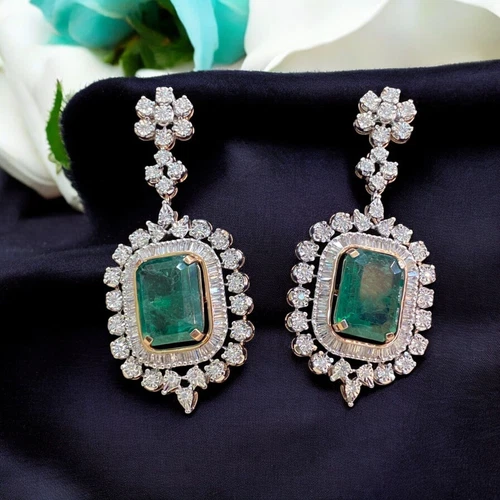
The best clues that an emerald is real are inside the stone. Natural emeralds almost always show small inclusions under a 10x loupe, while green glass tends to show round gas bubbles and swirl marks. A large emerald that looks completely flawless is more likely to be lab-grown or fake. Home checks can narrow it down, but only a gemologist's tests or a lab report can confirm a natural emerald.
What Is an Emerald?
Emerald is the green variety of the mineral beryl, colored by traces of chromium and vanadium. It's a hard stone, around 7.5 to 8 on the Mohs scale, but more brittle than diamond, sapphire or ruby, and it can chip if it takes a knock. That's one reason the emerald cut, a rectangular step cut with trimmed corners like the stones in the earrings pictured, became so closely tied to it: the cut corners help protect the stone.
Clue 1: Look Inside With a Loupe
Inclusions are so normal in emeralds that the trade has a name for them: jardin, French for garden, because they can look like moss or foliage inside the stone. Natural inclusions look like wispy veils, tiny crystals, or fingerprint-like patterns.
Glass looks different. Look for round gas bubbles, swirl lines, and facet edges that are rounded or chipped, since glass is much softer than emerald and wears quickly.
Clue 2: Is It Too Perfect?
Fine natural emeralds that are both large and clean are rare and expensive. A big, vivid, flawless-looking emerald at a modest price is a warning sign that it may be lab-created or a simulant. Lab-created emeralds are real emerald chemically, grown in a lab, and they can have inclusions of their own, so telling them from natural ones often takes a gemologist.
Clue 3: Check for a Seam
Some fakes are assembled from layers. A doublet or triplet glues a thin green layer between colorless pieces of quartz or beryl, so the stone looks green from the top. Look at the stone from the side for a straight line or a change in color partway down. In bezel settings, the seam can be hidden under the metal.
Clue 4: Know What Testers Can't Tell You
Diamond testers aren't designed to identify emeralds. Some gemologists use a Chelsea filter, which makes many natural emeralds glow red or pink, but it isn't conclusive: some natural emeralds don't react, and some lab-created ones react strongly. A gemologist's refractometer, polariscope and microscope give much better answers, and for an important stone, a report from an independent lab like GIA, AGL, Gübelin or SSEF states whether it's natural, how it's been treated, and sometimes where it was mined.
Are Emeralds Treated?
Most are. Emeralds are routinely filled with oil or resin to make surface-reaching fractures less visible, and this is a long-accepted practice when it's disclosed. Labs grade the treatment as none, minor, moderate or significant. Untreated emeralds with fine color are rare and command a premium.
Treatments can change over time, and heat or harsh cleaning can drive the filler out. Never put emerald jewelry in an ultrasonic cleaner or steamer. Here's how to clean jewelry with gemstones safely.
What Makes an Emerald Valuable?
- Color — the most important factor. The most prized emeralds are a vivid green to slightly bluish green, in a medium to medium-dark tone. Very pale stones are often called green beryl and are worth far less.
- Clarity — inclusions are expected, but a stone that looks clean to the eye is worth more.
- Size — larger fine emeralds are much rarer.
- Treatment — less is better, and documented "no oil" stones are the most valuable.
- Origin — Colombian emeralds carry a strong reputation, with Zambia and Brazil also major sources. Origin matters most when a lab report confirms it.
What Is Emerald Jewelry Worth When You Sell It?
Emerald jewelry is valued in parts. The gold or platinum is weighed and priced on its karat. Accent diamonds, like the baguette and round diamonds framing the emeralds pictured, add value based on their size and quality. Then there's the emerald itself: commercial-grade emeralds, heavily included or heavily treated, add a modest amount, while fine natural stones with a lab report can be the most valuable part of the piece. Lab-created emeralds add little.
Older pieces can carry extra value for their design. See our estate jewelry page, and our guides to sapphires and rubies for the other big colored stones.
Frequently Asked Questions
How can you tell if an emerald is real at home?
Look at it under a 10x loupe. Real emeralds usually show small natural inclusions, while glass often shows round bubbles, swirl marks and worn facet edges. Check the side of the stone for a glued seam, which points to a doublet or triplet. Home checks can rule fakes out, but only a gemologist or a lab report can confirm a natural emerald.
Are emeralds with inclusions fake?
No. Inclusions are expected in natural emeralds, and a few are completely normal. Clarity still affects value: an emerald that looks clean to the eye with strong color is worth more than a heavily included one.
Are lab-created emeralds worth anything?
Lab-created emeralds are real emerald chemically, but they cost far less than comparable natural stones and have low resale value. Jewelry set with them is valued mainly on its metal and any diamonds.
Do emeralds hold their value?
Fine natural emeralds with strong color, good clarity and minimal treatment have held their value well, especially with a lab report. Commercial-grade emeralds in mass-market jewelry resell for far less than their retail price.