
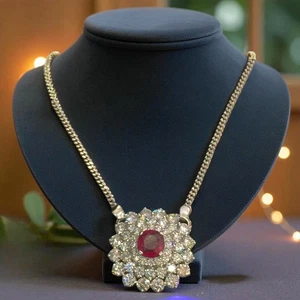
Real rubies are hard, usually show some natural inclusions under a loupe, and have a strong red that glows rather than looking glassy. Red glass shows bubbles and worn facets, and lab-created ruby is often suspiciously flawless. The biggest trap is the glass-filled ruby: low-grade ruby whose fractures are filled with glass. Here's how to spot each one, and what makes a real ruby valuable.
Ruby and Sapphire Are the Same Mineral
Ruby is red corundum, colored by chromium. Every other color of corundum is called sapphire. That makes ruby very hard, 9 on the Mohs scale, second only to diamond among common gems. Hardness is one of the easiest clues: a real ruby keeps sharp facet edges after years of wear, while softer imitations get scuffed and rounded. For sapphire's side of the family, see how to tell if a sapphire is real.
The Glass-Filled Ruby Problem
Glass-filled rubies are heavily fractured, low-grade rubies that have been filled with lead glass to make them look clearer and redder. They're sold widely, sometimes simply as "ruby" or under names like "composite ruby," and they can look good at first glance. Under a loupe, the signs include:
- Gas bubbles trapped in the glass inside the stone.
- A flash effect — blue or orange flashes of color along filled cracks as you tilt the stone.
- Patches with a different shine where glass reaches the surface.
Glass-filled rubies are worth very little, and they're fragile: heat from a jeweler's torch, and some household chemicals, can damage the glass. Ultrasonic cleaners are best avoided too.
Lab-Created Ruby
Ruby was the first gemstone to be made in a lab commercially, in the early 1900s, and lab ruby has been common ever since, especially in class rings and vintage jewelry. It's real ruby chemically, but inexpensive. The most common type often shows curved growth lines and small gas bubbles under magnification, along with very even, intense color and no natural inclusions. Some newer lab methods are harder to detect and need a gem lab.
Look-Alikes: Garnet, Spinel and Glass
- Garnet — usually a darker, more brownish or purplish red, and a real gemstone in its own right.
- Red spinel — so similar that some famous "rubies" in royal collections, including the Black Prince's Ruby in the British crown, turned out to be spinel. Natural spinel is valuable on its own, but lab-made red spinel is common in inexpensive jewelry.
- Red glass — bubbles, swirls, a glassy look and worn edges.
- Doublets — a thin top layer glued to a cheaper base. Look for a seam from the side.
What Makes a Ruby Valuable?
- Color — the most important factor. A vivid, pure red to slightly purplish red is most prized; the trade term "pigeon's blood" is used for the very finest. Stones that are too dark, brownish or pinkish are worth less.
- Clarity — some inclusions are normal, but eye-clean fine rubies are rare.
- Size — large fine rubies are rarer than diamonds of the same size and can be worth more per carat.
- Treatment — heat treatment is standard and accepted. Unheated rubies with a lab report command a premium, and glass-filled stones are at the bottom of the scale.
- Origin — Burmese (Myanmar) rubies carry the strongest reputation, with Mozambique and Thailand also important sources. Origin matters most when confirmed by a lab such as GIA, AGL, Gübelin or SSEF.
What Is Ruby Jewelry Worth When You Sell It?
Ruby jewelry is valued in parts. The gold chain and setting are weighed and priced on their karat. Surrounding diamonds, like the cluster around the ruby pictured, are valued by size and quality; small diamonds trade at low prices per carat, as we explain in cluster diamond ring value. Then the ruby itself: glass-filled and lab-created rubies add little, commercial-grade natural rubies add a modest amount, and fine natural rubies with a lab report can be the most valuable part of the piece.
Have other colored stones? See our guide to emeralds, and our estate jewelry page for older pieces.
Frequently Asked Questions
How can I tell if my ruby is real?
Under a 10x loupe, a real ruby usually shows natural inclusions and keeps sharp facet edges. Gas bubbles and blue or orange flashes along cracks point to a glass-filled ruby, curved growth lines point to a lab-created one, and bubbles with worn edges point to glass. A gemologist or lab report gives the definitive answer.
Is a glass-filled ruby a real ruby?
It contains real ruby, but it is filled with so much glass that it is valued as a treated composite, not as a fine ruby. It is worth very little and needs gentle care, because heat and some chemicals can damage the glass.
Are lab-created rubies worth anything?
Lab-created rubies are real ruby chemically, but they are inexpensive to produce and have low resale value. Jewelry set with them is valued mainly on its metal and any diamonds.
Are rubies worth more than diamonds?
Fine rubies can be worth more per carat than diamonds, and large top-quality rubies are rarer than diamonds of the same size. But most rubies in everyday jewelry are commercial grade, treated or lab-created, and are worth far less.