
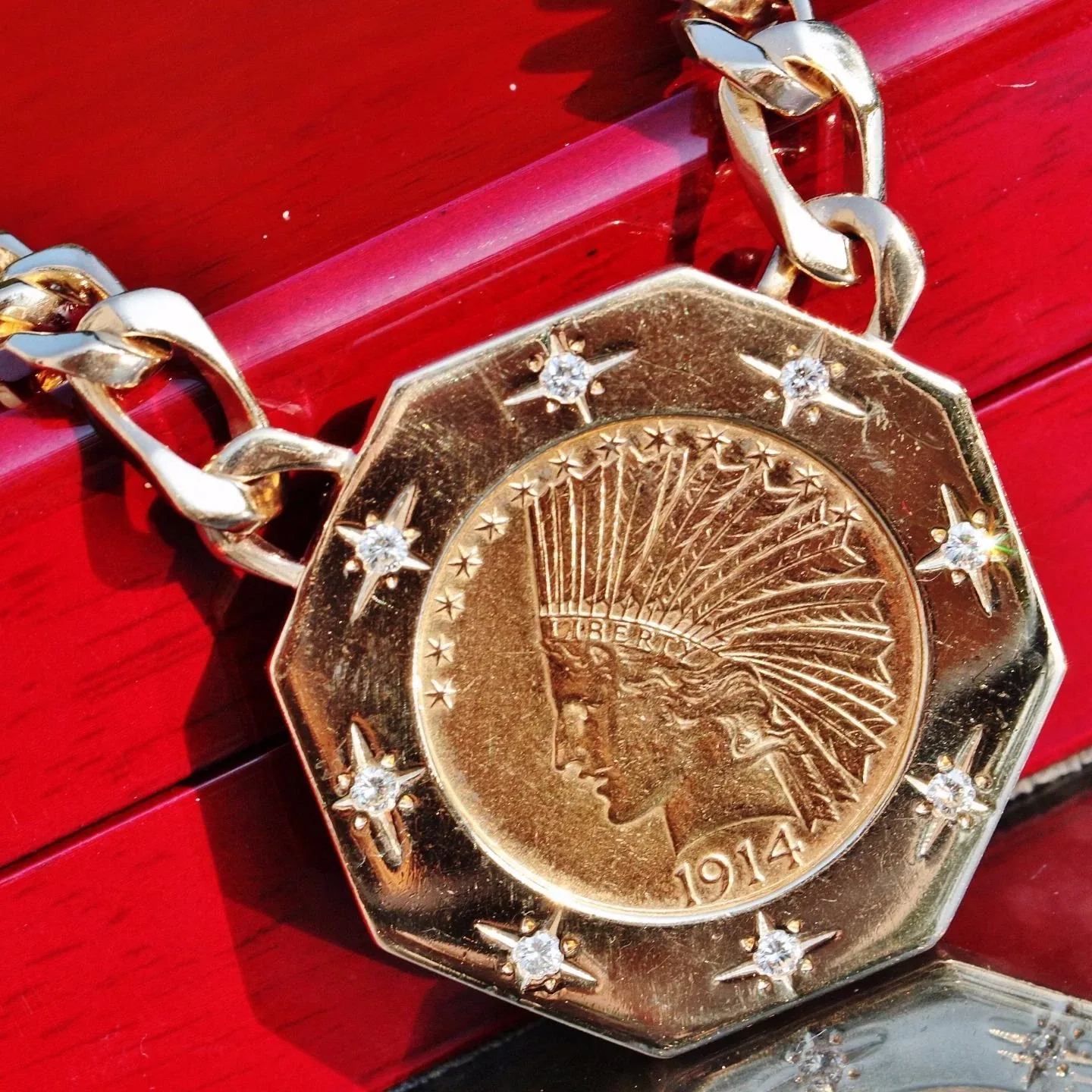
The Indian Head design is one of the most recognizable in American coinage — a Native American headdress on one side, an eagle on the other, struck in gold from 1907 to 1933. If you've come across one, in a drawer, an inherited collection, or set into a pendant like the one pictured here, it's worth understanding why these coins routinely sell for more than their gold content alone.
The Gold Floor
Every $10 Indian Head eagle contains 0.4837 troy ounces of pure gold — that number never changes regardless of date or condition. At minimum, the coin is worth that weight priced against the day's spot rate. This is the floor, not the ceiling.
Why Some Dates Are Worth More
These coins were struck at multiple U.S. Mint facilities — Philadelphia, Denver, and San Francisco — and mintage numbers varied enormously by year and location. Some years produced millions of coins; others produced only a few hundred thousand or less. Lower mintage generally means fewer coins survive today, and collectors pay a premium to fill in scarce years for a complete date set.
The coin pictured is dated 1914 with no visible mint mark, indicating Philadelphia. Depending on exact condition and any mint mark variant, coins from this era can carry a modest to significant premium over straight melt value.
Condition Changes Everything
Wear from decades of handling reduces detail on the headdress feathers and the eagle's wing, and that detail loss directly affects grade. A coin in well-preserved, high-grade condition can be worth substantially more than the same date in heavily worn condition — sometimes multiples of the melt value. This is why we always look closely at the coin's surface and strike quality, not just its weight.
What About Coins Set Into Jewelry?
Plenty of Indian Head eagles ended up mounted into pendants and cufflinks over the decades, often with a decorative bezel and small diamond accents like the piece shown here. Mounting doesn't erase the coin's gold content, but it can reduce numismatic premium for collectors who prefer coins in original, unaltered condition. If the coin turns out to be a scarcer date, we'll factor that in — otherwise, we price it primarily on gold weight plus the bezel's own metal content.
How to Get an Accurate Read
Bring the coin in and we'll identify the exact date and mint mark, assess the surface condition, and check current collector demand for that specific combination before quoting a number. It only takes a few minutes, and there's no obligation to sell.