
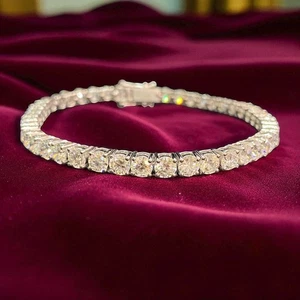
A diamond tennis bracelet is worth the value of its diamonds plus its gold or platinum. The biggest single factor is the size of each individual stone: a bracelet with fewer, larger diamonds is worth far more than one with the same total carat weight spread across many tiny stones. Whether the diamonds are natural or lab-grown makes an even bigger difference.
What Makes It a Tennis Bracelet?
A tennis bracelet is a single, flexible row of matched stones, usually round diamonds, each in its own small setting. The name is usually traced to tennis star Chris Evert, who stopped a match to look for a diamond line bracelet that had fallen off her wrist. Before that, the same design was simply called a line bracelet, and some jewelers still use that name.
Total Carat Weight vs. the Size of Each Diamond
Tennis bracelets are sold by total carat weight, the combined weight of every stone, often stamped on the clasp as something like 3 CT TW. It's a useful number, but on its own it doesn't tell you much about value.
Diamond prices climb steeply with the size of each stone. A bracelet of fifty small diamonds and a bracelet of thirty larger ones can share the same total weight, but the one with larger stones is worth considerably more, because a single larger diamond is much rarer than several small ones. For a sense of scale, a well-cut round diamond of 0.10 carat is about 3 mm across.
Consistency matters too. In a good bracelet, every stone is close in color, clarity and size, so the row looks even from end to end. Stones that vary or look grey or yellowish next to their neighbors bring the value down. We explain why small diamonds trade at low prices per carat in cluster diamond ring value.
How Can You Tell If a Tennis Bracelet Is Real?
Start with the clasp. The box clasp is where you'll usually find the metal stamp (14K, 18K, PT950, or 925 for sterling silver) and sometimes the total diamond weight. Then the stones need testing:
- A diamond tester quickly separates diamond from cubic zirconia, which also tends to look scratched and cloudy after years of wear.
- A moissanite tester is needed too. Moissanite tennis bracelets have become very common, and moissanite can read as diamond on a basic thermal tester. It also tends to throw stronger rainbow flashes than diamond.
- Test several stones along the bracelet, not just one. Repaired bracelets sometimes have replacement stones.
What no handheld tester can do is tell natural diamonds from lab-grown ones, since lab-grown diamonds are real diamond. Paperwork is the main way to document natural stones. More on why that matters in lab-grown vs. natural diamonds, and on testing in general in how jewelry gets tested.
Settings, Clasps and Condition
Most tennis bracelets use four-prong or three-prong settings, or a bezel that wraps each stone in metal. Some use illusion plates, polished metal around each small diamond that makes it look larger than it is.
Because tennis bracelets flex constantly, condition is worth checking before you sell:
- Loose or missing stones — shake the bracelet gently near your ear and look for any stone that moves.
- Worn prongs — prongs that catch on clothing are often thin or bent.
- The clasp and safety — the box clasp should click shut firmly, and the safety catch on the side should still lock.
- Kinks — a bracelet that won't lie flat may have a stretched or damaged link.
What Is a Tennis Bracelet Worth When You Sell It?
When we value a tennis bracelet, we look at the metal and the stones separately. The gold or platinum is weighed, after allowing for the weight of the stones, and priced on its karat. The diamonds are judged on the size of each stone, their color and clarity, how well they match, and whether they can be documented as natural.
- Natural diamonds, larger individual stones — the strongest resale value, especially with good color and matching.
- Natural diamonds, many small stones — the metal plus a modest amount for the diamonds.
- Lab-grown diamonds or moissanite — valued mainly on the gold or platinum, since the stones have low resale value.
- Sterling silver with cubic zirconia — worth little beyond the silver itself.
As with most diamond jewelry, expect a resale offer to sit well below the original retail price. A bracelet from a major designer house can sell for more than its materials, especially with its box and papers. If you also have a diamond necklace in the same style, see what determines a tennis necklace's resale value.
Frequently Asked Questions
How can I tell if my tennis bracelet is real?
Check the clasp for a metal stamp like 14K, 18K or PT950, then have the stones tested with both a diamond tester and a moissanite tester, on several stones along the bracelet. A stamp alone is not proof, and no handheld tester can tell natural diamonds from lab-grown ones.
Is a lab-grown diamond tennis bracelet worth anything?
Yes, but mostly for its metal. Lab-grown diamonds have low resale value, so a lab-grown tennis bracelet is valued mainly on the weight and karat of its gold or platinum.
Why is my tennis bracelet worth less than its carat weight suggests?
Total carat weight adds up many small stones, and small diamonds are worth much less per carat than larger ones. A bracelet with the same total weight in fewer, larger stones is worth considerably more.
What metal are tennis bracelets usually made of?
Most fine tennis bracelets are 14K or 18K white or yellow gold, and some are platinum. Fashion versions are often sterling silver with cubic zirconia. The stamp on the clasp is the first thing to check.