
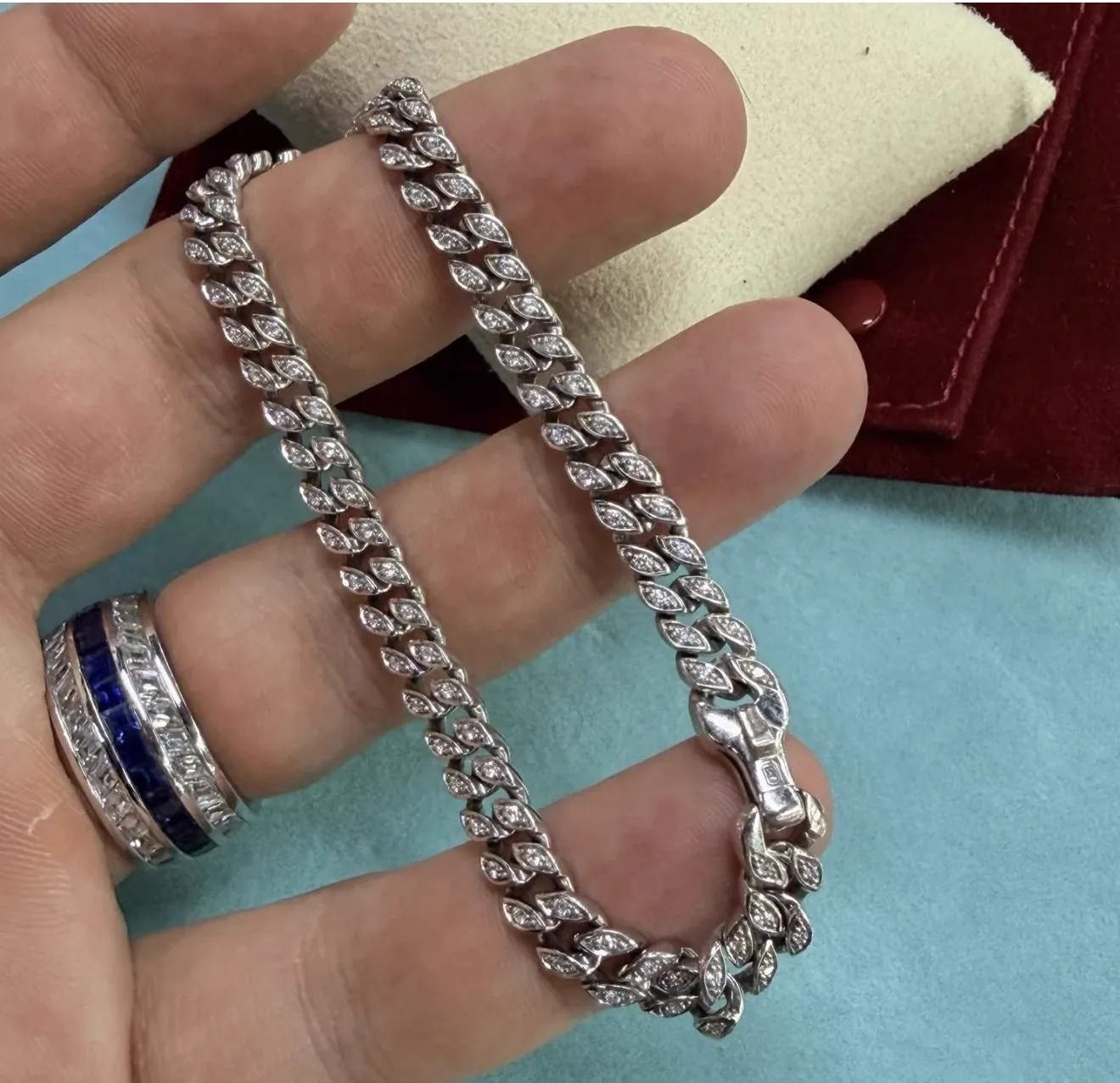
A pavé Cuban link bracelet like the one pictured looks the same from across the room whether it's set with natural diamonds, lab-grown diamonds, moissanite or cubic zirconia. Up close and on the scale, those four bracelets are worth very different amounts. If you're thinking about selling one, or buying one secondhand, here's what actually decides the number.
What "Diamond Cuban Link" Can Actually Mean
A Cuban link is a curb chain with thick, interlocking links that lie flat. The iced-out versions add small stones pavé-set across the face of every link, usually two or three per link, plus more on the clasp. Sellers call almost all of them diamond bracelets, so it helps to know the four materials you'll actually run into:
- Natural diamonds — mined stones. On a bracelet these are almost always tiny melee diamonds, often just a point or two each. A point is one hundredth of a carat.
- Lab-grown diamonds — real diamond, chemically the same as natural, grown in a lab. They've become very common in iced-out pieces because they cost far less.
- Moissanite — a different gemstone, silicon carbide. Very bright, very hard, and a popular diamond substitute.
- Cubic zirconia (CZ) — an inexpensive simulant. Sparkly when new, but it scratches and clouds over time.
The metal varies just as much. Iced-out Cuban bracelets are made in solid 10K, 14K and 18K gold, in sterling silver, and in plated brass or stainless steel.
Check the Clasp First
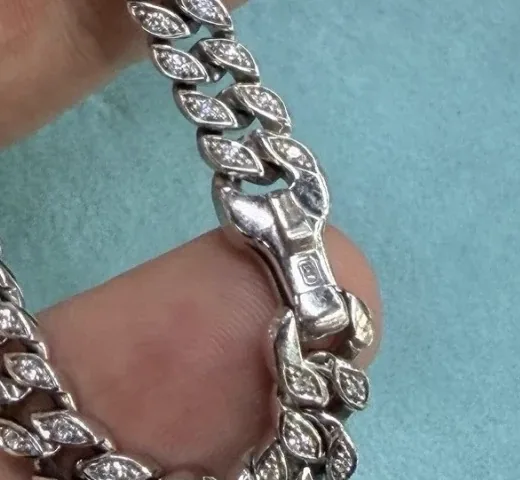
Most Cuban bracelets close with a box clasp like this one, and that's where makers put the stamp. Look for a karat mark (10K, 14K, 18K, or 417, 585, 750), 925 for sterling silver, and sometimes a maker's mark or a stone weight like 2.00 CTW.
A stamp tells you what the maker claimed, not what's actually there. Clasps get swapped, stamps get faked, and a silver bracelet can carry a gold-plated clasp. We confirm the metal with testing before we quote. Here's how jewelry gets tested, method by method.
How the Stones Get Tested
A thermal diamond tester separates diamond from CZ quickly, but moissanite can read as diamond on a thermal tester alone. That's why the stones should be checked with a tester that also measures electrical conductivity, which catches moissanite.
It's worth testing several links across the bracelet, not just one. Repaired bracelets sometimes have replacement stones that don't match the rest.
What no handheld tester can do is tell natural diamonds from lab-grown ones. Tiny melee rarely comes with paperwork, so a bracelet without documentation is hard to prove natural. For why that difference matters so much on resale, see lab-grown vs. natural diamonds.
What Each Version Is Worth
Here's where the four versions split apart:
- Moissanite or CZ on solid gold — valued on the gold. The stones add little or nothing on resale, so the offer comes down to the bracelet's gold weight and karat.
- Lab-grown diamonds on solid gold — still mostly gold value. Lab-grown melee has very little resale value.
- Natural diamonds on solid gold — the gold plus something for the diamonds, depending on how many there are, their size and quality, and their condition.
- Any stones on silver or plated metal — sterling silver has modest metal value, and a plated bracelet has no precious-metal value at all.
Even with natural diamonds, the stones usually add less than people expect. Melee is bought and sold in bulk by the carat at prices far below what it adds to a retail price tag, and getting hundreds of tiny stones out of their settings takes labor. On most iced-out bracelets, the gold is the biggest part of the offer.
Why the Gold Weight Isn't the Bracelet's Weight
Stones weigh something too. One carat is 0.2 grams, so a bracelet with 3 carats of stones carries about 0.6 grams of stone. A careful buyer deducts an estimate for the stones, and for any non-gold parts like the small steel spring inside many clasps, before working out the gold value.
Iced-out bracelets also vary a lot in construction. Some have hollow links or thin backs under all those settings, so two bracelets of the same width can weigh very differently. For how weight and karat turn into an offer, see how gold buyers calculate offers, and for the plain gold version of this bracelet, gold Cuban link bracelets: sizing, weight and resale value.
Condition Checks That Move the Price
- Missing or loose stones — a gap in the pavé is easy to spot under a loupe, and loose stones rattle when the bracelet is shaken gently.
- Worn beads and prongs — pavé stones are held by tiny beads of metal that wear down over years of daily wear.
- The clasp — a box clasp that pops open on its own needs repair, and the side safety latches should still lock.
- Kinks and stretched links — Cuban links should lie flat. Twisted or stretched sections point to damage or a past repair.
None of this makes a bracelet unsellable. Broken and damaged gold jewelry is still bought for its gold content. More on that on our broken and scrap jewelry page.
Bringing One In
Bring the bracelet along with any receipt, certificate or box you have. Paperwork matters most on diamond pieces, since it can document natural diamonds and their total weight. We test the metal and a sample of stones in front of you, weigh the piece, and explain how we got to the number. You can also text photos first, including a close shot of the clasp stamp, for a quote before you make the trip.
Selling other diamond jewelry too? The same thinking applies to diamond tennis necklaces, and our diamond buying page covers everything else we buy.
Frequently Asked Questions
How can I tell if my iced-out Cuban bracelet has real diamonds?
Start with the clasp stamp and any paperwork, but the reliable answer comes from testing. A thermal tester separates diamond from CZ, and a tester that also measures electrical conductivity is needed to rule out moissanite. Testing several links catches replaced stones. No handheld tester can tell lab-grown diamonds from natural ones.
Is a moissanite Cuban link bracelet worth anything?
If it is solid gold, yes. It is worth its gold weight at its karat, while the moissanite itself adds little on resale. A moissanite bracelet in sterling silver or plated metal is worth much less.
Do the diamonds or the gold matter more on a diamond Cuban bracelet?
For most bracelets, the gold. Pavé bracelets use many tiny melee diamonds, which have low resale value per carat compared with larger stones. Natural melee in good condition adds to the offer, but the gold weight is usually the bigger number.
Can I sell a diamond bracelet with missing stones?
Yes. Missing stones lower the value of the stones and may mean the bracelet is valued mainly on its gold, but damaged and broken gold jewelry is still bought for its metal content.