
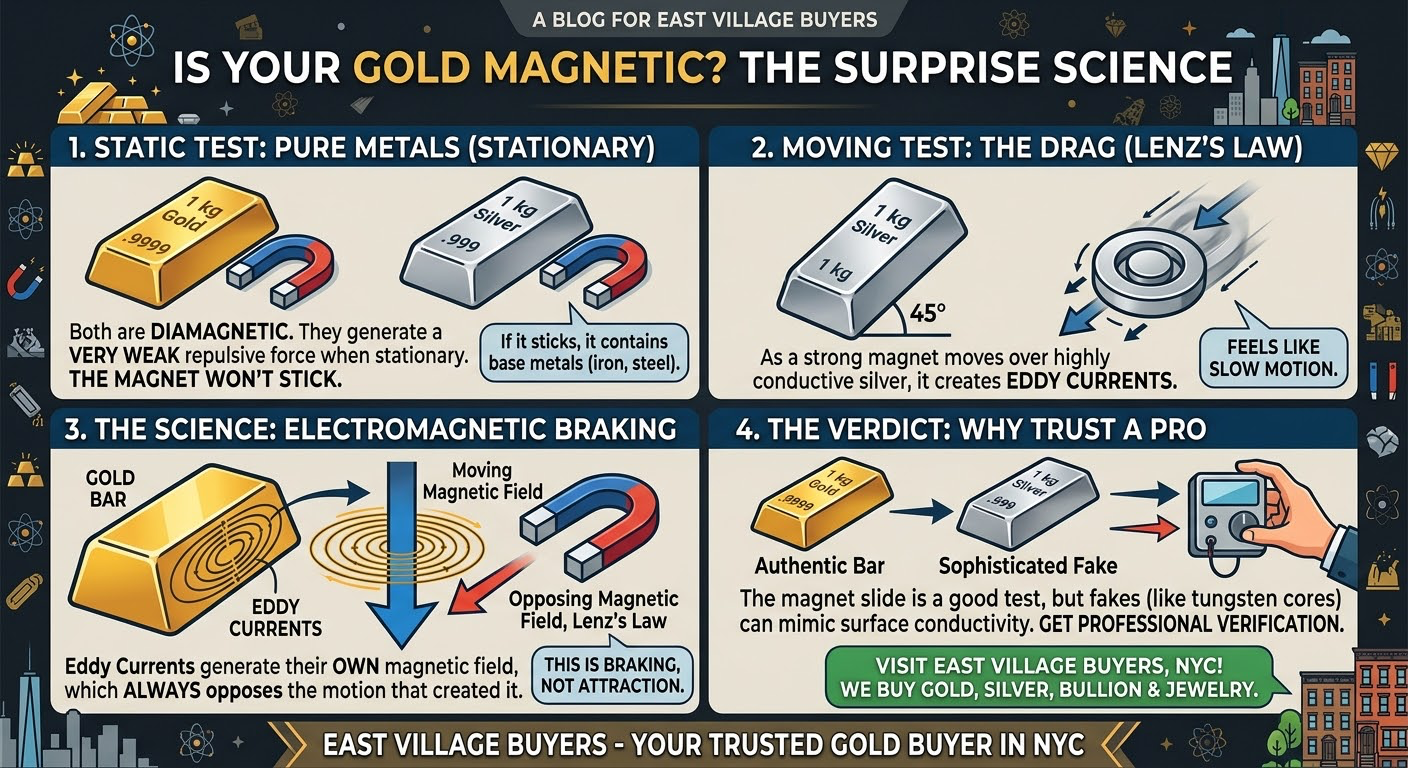
Place a magnet on a 1 kg gold bar or 1 kg silver bar and feel resistance? Most people assume it's fake, but real physics tells a different story.
Pure gold (.9999) and silver (.999) are never ferromagnetic. A stationary magnet will not stick. Both are diamagnetic metals, repelling magnetic fields so faintly that you cannot feel it by hand. If a bar snaps to a magnet, it contains cheap base metals like iron or steel.
However, move a strong neodymium magnet across a 1 kg silver or gold bar, and you will feel a mysterious drag. Tilt the bar at an angle, and the magnet slides down in slow motion, like it's gliding through thick syrup.
This isn't magnetic attraction—it is electromagnetic braking governed by Lenz’s Law and Faraday’s Law of Induction:
While a magnet slide is great educational science, advanced counterfeits can mimic surface conductivity. That is why professional verification matters.
We Buy Gold & Silver in NYC
At East Village Buyers, we buy gold, scrap gold, silver bars, bullion, coins, and estate jewelry. We use advanced, non-destructive testing for complete transparency. Stop by our NYC shop for an immediate appraisal!
- High Conductivity: Silver is the most conductive metal on Earth; gold follows closely behind.
- Eddy Currents: As the magnet moves, it induces swirling electrical currents inside the metal.
- Opposing Fields: Lenz’s Law states these currents generate their own magnetic field that actively pushes back against the moving magnet, creating a friction-free braking effect.