
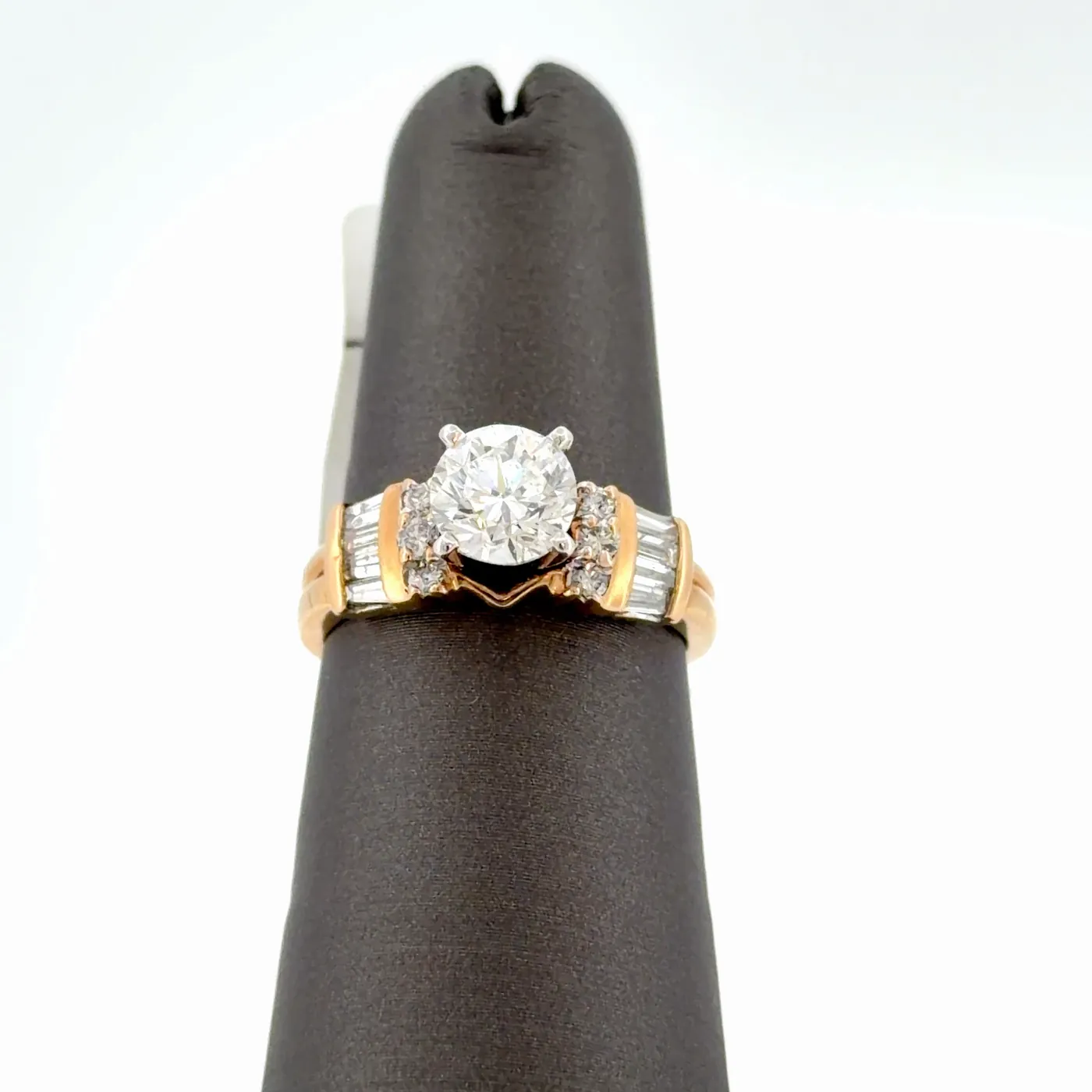
Most people think of an engagement ring as one thing with one price. A buyer sees three: the center diamond, the smaller side stones, and the metal. The ring pictured here is a good example. It has a round brilliant center held in four white prongs, three small round diamonds on each side, and tapered baguettes channel-set into a yellow gold band. Each of those parts is valued differently, and knowing how helps you make sense of any offer you get.
The Center Stone Carries Most of the Value
On a solitaire-style ring, the center diamond is usually the largest part of the offer by far. It's judged on the four Cs:
- Carat — the stone's weight. Value rises steeply as diamonds get bigger, and it jumps at popular sizes like half a carat and one carat.
- Cut — how well the stone is proportioned and polished, which drives its brightness and sparkle.
- Color — from colorless to faint yellow. Whiter stones are worth more.
- Clarity — how many inclusions the stone has and how visible they are.
If the stone came with a grading report, bring it. A report from a respected lab like GIA documents the grades and makes the stone easier to price. Here's what a GIA certificate actually proves.
Older rings often have no paperwork, and that's fine. A buyer can estimate the weight from the stone's measurements while it's still in the setting. A well-cut round diamond about 6.5 mm across is roughly one carat, for example. The grades are then judged under magnification.
One more question matters more than ever: natural or lab-grown. Lab-grown diamonds are real diamond, but their resale value is far lower than natural, and a handheld tester can't tell the two apart. That's another reason a grading report helps. More in lab-grown vs. natural diamonds: what actually holds value.
Side Stones, Baguettes and Melee
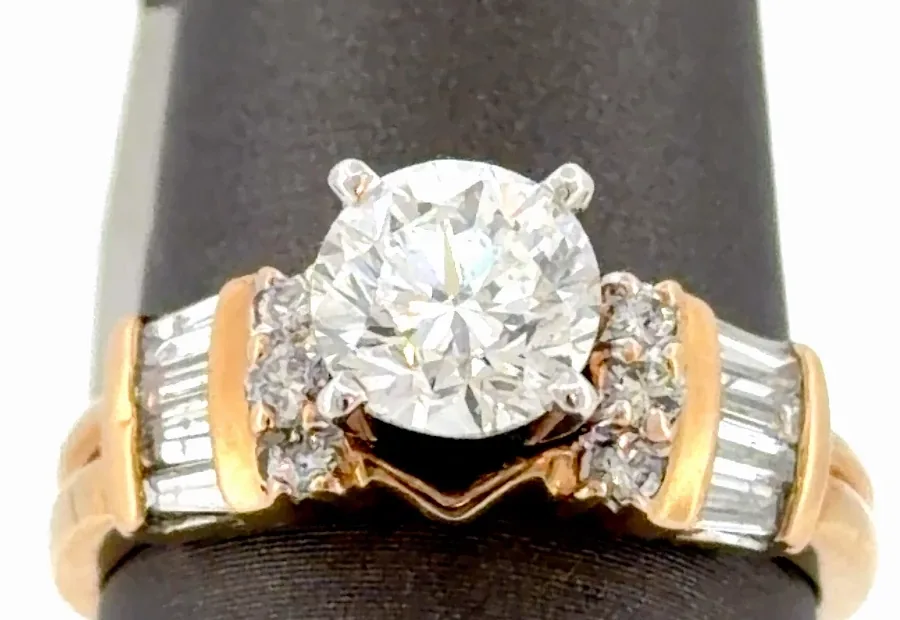
The smaller diamonds dress up the ring, but they add much less than most people expect. Round side stones and pavé are melee, which trades at low prices per carat. We go into why in cluster diamond ring value.
Tapered baguettes are long, narrow step-cut diamonds set in a channel along the shoulders, a classic look that was especially popular in the 1980s and '90s. Small baguettes are valued like other small diamonds, by size, quality and condition, at modest per-carat prices. Their pointed corners are fragile, and a chipped corner lowers a baguette's value further.
The Gold or Platinum Setting
The mounting is valued mostly on its metal: the karat or platinum content and the weight, after deducting the stones. One carat equals 0.2 grams, so the diamonds come off the scale weight before the metal is priced.
Many rings in this style pair a yellow gold band with white prongs around the center, which makes the diamond look whiter against the setting. On two-tone rings, both metals get checked.
The design and labor that went into the setting usually don't come back on resale. The exceptions are signed pieces from well-known jewelry houses and genuine antique and estate settings, which can sell for more than their materials. See our estate jewelry page if your ring is an older piece.
Three Ways to Sell an Engagement Ring
You have options, and the best one depends on what you want to keep:
- Sell the whole ring. The simplest route: one offer that covers the center stone, the side stones and the metal.
- Keep the center stone, sell the setting. Common when someone wants to reset a family diamond into a new design. The old mounting is sold for its gold and small stones.
- Sell the center stone on its own. If you'd like to keep the band, or the setting has sentimental value, a jeweler can remove the center diamond so it can be sold by itself.
What Resale Value Really Looks Like
It's normal for a resale offer to come in well below what the ring cost new. The retail price included design, labor, overhead and markup, which we cover in why retail jewelry markup kills resale value. Store appraisals usually list an insurance replacement value, which is higher again.
Resale is based on what the diamond and the metal are worth on the secondary market today. The rings that hold value best are the ones with a strong, documented natural center stone, because that's where the value is concentrated.
Before You Sell
- Gather the grading report, receipt or appraisal if you have them.
- Clean the ring gently so the center stone can be seen clearly.
- Decide what you want to keep: the whole ring, the stone or the setting.
- Ask for the offer to be broken down by center stone, side stones and metal.
- Have it evaluated in person. Diamonds are graded with a loupe and testers, not from a photo, though photos are a fine start for a quote.
Selling a ring after a breakup, a divorce or a loss is never just a transaction. Take your time: an evaluation is free, and there's never an obligation to sell. When you're ready, our engagement ring buying page walks through the process, and how to sell diamonds in NYC covers loose stones.
Frequently Asked Questions
How much can I sell my engagement ring for?
It depends mostly on the center diamond: its carat weight, cut, color and clarity, and whether it is natural or lab-grown. The side stones and the gold or platinum add to that. Expect a resale offer to be well below the original retail price or an insurance appraisal.
Is the setting worth anything when I sell my ring?
Yes, mainly for its metal. The setting is valued on its gold or platinum weight, plus any small diamonds in it. Signed designer settings and genuine antique settings can be worth more than their materials.
Do I need a GIA certificate to sell my engagement ring?
No. A grading report makes the center stone easier to price, but a ring without paperwork can still be evaluated by measuring and examining the stone in person.
Can I sell just the diamond and keep the band?
Yes. A center stone can be removed from its setting and sold on its own, so you can keep the band or the mounting.